Thanks Again Marja-liisa
Introduction
An interest in research of perilous experiences is situated in the liminal zone between fine art, artistic research, humanities and social sciences besides medical and neuroscience. In modern scientific discipline, the uncanny or kumma has non been a relevant object for proper studies and consequently, has remained merely excluded or a strange surplus. The Freudian term 'Unheimlich'[one] corresponds well to what in Finnish is called kumma, significant weird or odd. Notwithstanding, this is non the case with weird experience as interpreted in religious or esoteric discourses, phantasy or amusement art or as an artful experience. In our society, unless kumma is not interpreted appropriately, it would go a target for psychiatric classification past which information technology is ranked equally a sign of mental disorder with astringent and oft lifelong consequences of stigma. In addition, modern theories of mind tend to interpret kumma as an intrapersonal and private experience of bounded human mind currently, in increasing frequency, as an object of neuroscience. Our aim with the installation Connecting Phone Booths, presented at the CARPA conference is the opposite – to sympathise kumma in an intersubjective, contingent social space.
This paper is background for our installation. Its focus is on the loneliness of the kumma experience and its vicissitudes in scientific studies and order. In the interdisciplinary research project Heed and the Other,[2] funded by the Academy of Republic of finland, viii scholars in social sciences and the humanities studied people'south perilous, uncanny experiences: e.yard. visions, sounds, apparitions, telepathy, pre-seeing, encounters with the dead or automatic writing, in the course of start-person experiences. Hearing voices without a visible source is 1 of these experiences. Interestingly, kumma is often expressed with similar terms people have used when describing something as holy, a miracle, unexpected: unspeakable or indescribable and ever without any witness. The experiences frequently appear unexpectedly, in the midst of an everyday chore, in familiar conditions and they have the ability to change the familiar into something uncanny. They can be perceived every bit sources of inspiration or every bit an affective dimension of creativity. However, the dark side of the interpretation is as well truthful with the consequences of probable lifelong stigma.
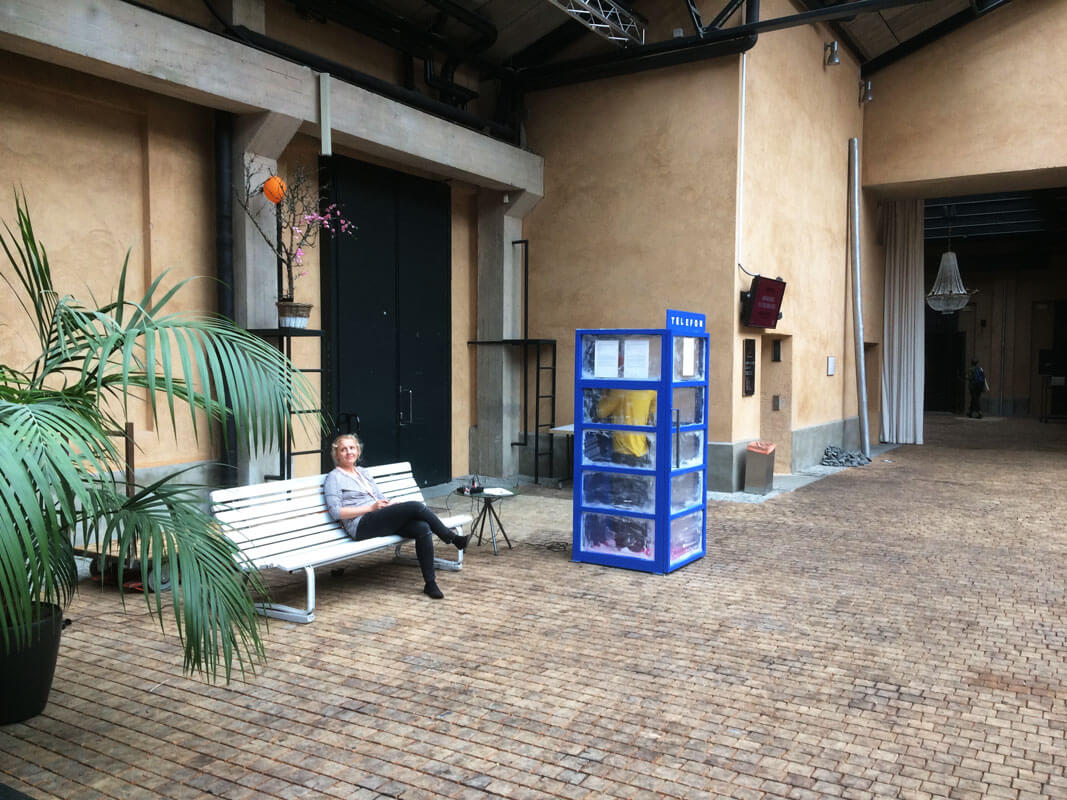
The installation Connecting Telephone Booths that our group [iii] set out during the CARPA conference intertwines the scientific, scholarly perspectives on kumma with the arts. Practically, the installation was carried out with help of the Theatre Academy that opened a public telephone berth in the main hall with a possibility for a call contact betwixt a voice hearer and a conference participant every bit a listener. We asked people who hear voices without a visible source [4] to give a call to the booth and tell virtually their experience and what the voices were talking about. Anyone passing by was able to answer the telephone and hear a personal experience of the voice hearers and was consequently able to share their own experiences. Birthday nine voice hearers phoned the booth.
-

- Riku Saastamoinen
-
- Riku Saastamoinen
Our installation was built like a kaleidoscope with the aim to report kumma by exposing it to both the arts and sciences and to bring kumma abroad from its desolation into a shared intersubjective space.
Why is Kumma a Stigmatized Feel in Modernistic Society?
Outside of the discourses and practices in the arts, the estimation of the uncanny in mod western cultures is mainly related to social and intellectual exclusion. Withal, outside the arts, more half of western people report uncanny experiences, defined as supernatural, paranormal or supranormal.[5] Tanya Luhrmann (2011) calls them sensory overrides [six] meaning sensuous experiences one has in the absence of a source to be sensed and Lisa Blackman (2012) describes them as the homo potential of affective and bodily engagement with the world. Considering how often these experiences occur and that they affect over half of the populations studied, they would better exist divers as "normal". However, what makes the phenomena contested and contributes to the main focus of this article is that exterior of the arts and artistic practices, the kumma phenomena in western societies are still widely regarded as deviant or pathological.[seven]
Scientific assumptions are neither innocent nor objective but based on social and cultural agreement of the world and how to study information technology. Max Weber highlights how principles such every bit rationality and efficiency became, along with modernization, the leading forces of modern society. Weber is quite strict with his argument:
The increasing intellectualization and rationalization do non, therefore indicate an increased and general knowledge of the atmospheric condition under which one lives. Information technology means something else, namely the knowledge or belief that if i but wished one could learn it at any time. Hence, it means that principally in that location are no mysterious incalculable forces that come into play only rather that one can in principle, principal all things by calculation. This means that the world is disenchanted. (Weber 1922/1967, 139)
Currently, what scholars in social sciences and religion call mail service-secularism (Keane 2013; Nynäs & Lassander 2012) has brought about new spiritual movements in guild and the emergence of what several authors (e.yard. Heelas & Woodhead 2005; Partridge 2005; Partridge 2004) telephone call 're-enchantment'; angels and spirits are perhaps more than than ever a part of the everyday. Still, most people, along with the main authorities and social institutions such as scientific discipline and medicine share the same ontological assumption: the phenomena are neither real nor true. This very point came upwardly when we started the research project Mind and the Other: the afternoon papers Ilta-Sanomat and Iltalehti published ridiculing comments most the futurity research of the project and claimed that the chief national research foundation is wasting coin for futile purposes (see Honkasalo 2017).
Opening Up a Shared Space for Unheimlich
The Mind and the Other project received over 200 spontaneous letters [viii] of experiences of kumma, which range from a variety of sensuous and multisensory, and always solitary experiences of intuitive thoughts and weird feelings to vivid and powerful experiences, described as unsayable and without anyone other witnessing them. Some people written report hearing voices, some encounter inexplicable things. In add-on, people recount, for example, feeling an obscure sense of presence or someone touching them when no one seems to be effectually. Another mutual blazon of experience is that of coming together the dead, involving dead family members, relatives, friends or pets. Some feel the presence of a deceased loved 1 or believe that a dead person comes to visit them in the class of a bird or gives them some kind of message or a sign. The feel of kumma is narrated every bit an unexpected, ofttimes extraordinary, uncontrolled, lonely uncanny disruption of their everyday life and of action and practices in the midst of everyday life.
At least in Finland, persons who tell about their sensory overrides – and those who do research on them – are prone to become categorized every bit deviant or even pathological. The anthropologist Joao Vasconcelos (2008, 22) puts this clearly by writing that the homelessness of the spirit in the globe of science is a correlate of the homelessness of the scientist who is committed to research on 'spiritual' or 'paranormal' phenomena. The boundary between normal and pathological has long historical roots and several social institutions, notably science, have played a remarkable office in the very processes of the dichotomous shaping of this rootedness (see Ganguilhem 1966/1978).
What makes the purlieus such a called-for outcome? What is so contested about things considered in scientific research neither existent nor true? Why are they almost taboos, especially in Republic of finland? Whether or not miracles happen and how to bear witness them has been a dispute over centuries in history and philosophy (eastward.thou. Keener 2011). Anthropologists, such as Mary Douglas (1966), argue that this kind of a purlieus is not a coincidence but a feature of the social system. The cosmos of order produces exclusion and outskirts, which, co-ordinate to Mary Douglas, is "dirt" not removed merely returning. The statement fits well to what people generally sympathise by rationality, science and scientific norms. The society constantly monitors the boundaries of its integrity and defends information technology against danger: violation, disloyalty, anomy, or pollution – also considering scientific truth and how scholars tin admission information technology. Stigmatization, or marking someone to be insane, is but one strategy. Yet others, notably in the field of scientific enquiry, differ significantly from those in the humanities or from people in everyday life considering the criteria for evidence. In natural sciences and the philosophy of science the main concern is about the rigor of evidence, such every bit verification and falsification. The prove of "dubiety", nevertheless, is especially true for people who are accused or victimized, leading to situations where their testimonies or other narrative proofs are effortlessly considered not to be legitimate and not worth of trust.
The trouble in this commodity is tackled on two levels. Drawing on the discussions in the studies of cultures ane) I ask an epistemological question of which kind of noesis is produced of and by kumma, 2) wait into the ethical problem of the value of beginning-person experience. These are immense themes for a curt article. What I desire to do is simply shortly sketch out how to report the uncanny through the sharp lens of the two, and by doing and then, to modestly contribute, as a scholar in the studies of cultures, to the problematization of some basic cultural assumptions of knowledge and ethics. I myself, every bit an anthropologist and a scholar in medicine, commenced my research on kumma as a lived and embodied experience. However, what I learned during my piece of work was that the noesis I was able to produce constituted merely a limited arroyo to kumma. I ended up at the limits of explanation in science – but, surprisingly, also of those of understanding. This is my background and the urge for the collaboration with the artists and artistic research that was launched with the Connecting Phone Booth.
Listen and Other – Some Vignettes for Understanding
William James' (1902) methodological point, co-ordinate to which because a given thing'due south exaggerations and perversions ever leads to a improve agreement of its significance constituted the leading thought for our project Mind and the Other. We defined our aim to study uncanny experiences as faculties of the man mind on its margins. James (1902, 334) highlights that phenomena "are best understood when placed within their serial, studied in their germ and in their over-ripe disuse, and compared with their exaggerated and degenerated kind."
In this article, I rely on the over 200 spontaneous letters as first-person narratives of uncanny experiences. What I want to do is to take seriously these experiences, by and large called "supernatural"; by seriousness I mean that I don't brand evaluations of their truth or whether they are valid for the experiencer, function of their reality. To practise research like this seemed to exist, already from the start, a contradiction in terms. The concepts available for Unheimlich in scientific research, such as 'supernatural' or 'paranormal', are already loaded with Western cultural assumptions of what is considered as natural or normal.
The messages we received consist mainly of narratives, in which the informants draw their experiences in more than or less detailed, almost in testimonial fashion. How to convince the listener, a shut one or an authority? Many of the uncanny experiences are described every bit multisensorial, solitary feelings. Seeing inexplicable things seem to exist the most common way to sense uncanniness.[9]
Ethics, Uncanny and Human being Mind
Every bit related to the discussions of epistemological and ontological dimensions of kumma in the studies of cultures, the problem of ideals has not a proper space. Past saying then, I mean that what is merely unthematized is how strongly one'due south upstanding position on the value of narratives of homo being is influenced by the ontological assumptions concerning corporeality and by the evidential assumptions of what is existent and what is true, as presented in social sciences and the humanities. In the following we hash out this in relation to three questions: 1) the upstanding position of the experiencer as a writer of the uncanny, two) that of the receiver and the audience, and finally iii) what the ontological assumptions mean for ane's possibilities for adept life.
People who wrote to united states nearly their experiences mention that they have not oftentimes shared the feel with others. This has been noted in before research (e.thou. Hufford 1982; Virtanen 1977). The reason mentioned as to why they rarely told anyone was to avert stigmatization or ostracism. Too, the feeling of not existence understood in the example of intense and embarrassing experience could be painful. Some told that they had encountered government in e.g.health care or the church with derogatory or pejorative attitudes. Many writers started their letters by request for assist from us as researchers, after having recurrently been disappointed with the encounters with other social institutions.
I have had a deep feeling of being unlike and not understood. I have been judged considering of my spirituality and considering I meet and experience more than others. Nowadays I hide this side of myself from all but those adept in these issues. If I want to manage in working life well plenty to earn a normal income, I cannot risk beingness labelled as a nutcase. (Laura MT71/1) [x]
However, what they wanted to write nearly, along with the descriptions of what happened to them, was a self-reflexive and disarming story of a responsible life. They fabricated a lot of attempt describing how and in which ways they tried to make sense of the uncanny experiences. Many books were read, many interpretative ways applied. Some writers shaped their own theories of the essence and the causes of the uncanny. What is ethically of import for us is the deep discrepancy and disproportion of ontological assumptions betwixt the author and the receiver. This leads to our kickoff indicate, that of the writer as an actor. The testimonial mode of the most letters was slightly amazing. The experiences were described in a highly detailed style, and the careful descriptions reminded of court cases. Folklorist Ulla-Maija Peltonen (2003) describes something similar in her research on the narratives of the widows whose men, having fought on the Reds' side, had disappeared during the Finnish Ceremonious War. The women made desperate attempts to convince state officials of their men's extinction, as the whole burden of proof was put on them. How to convince others about disappearance, the invisible and non-existing? Testimonies of this kind comprise certain sorts of speech acts belonging to the category of desperate bear witness providing. They illuminate the lacking prove in the meaning of not being able to communicate the experience in a proper way (Coady 1992). Though research on testimony has been rich in history, particularly among court cases and war victims, and more recently amidst refugees and asylum seekers, the bulk of literature originates from the studies of the narratives of the Holocaust survivors. Philosopher Martin Kusch (n.d.) describes the survivors' modes of creating evidence with two terms: linguistic despair and multitude of approaches. Linguistic despair is expressed by many narrators when trying to put their experiences into words in the situation where the listener does not share the feel, and where "socio-moral certainties have been destroyed using language presuppositions that these very certainties are in place" (ibid., 34). Likewise in the messages we received, the distinction between the earth of the writer and the reader is nowadays. The writers know that the readers exercise not share their world of feel and that they probably are unable to provide the kind of evidence that the country officials – including us equally researchers – want, show that is based on visual and quantitative criteria (Engelke 2008). This show could consist of equally detailed as possible written clarification of what the ungraspable was nearly, in all its "unsayablity". Those they aim to convince are more often than not wellness care personnel, notably medical and psychiatric doctors and nurses, and insurance professionals, besides as researchers. We examine the negotiations these groups undertake with land officials and how they try to make sense of their lives, thereby too addressing their needs. In our study, which compares the similarities and differences of the type of show presented, nosotros distinguish between the perspectives of "bear witness for", in the context of power hierarchies, and "show of" the truth of certain experiences (Csordas 2004).
The testimonial stories show that at the level of the state bear witness relies on the model of natural sciences where the ideal is provided by prove-based medicine (Derkatch 2016; Knorr-Cetina 1981). Therefore, the state authorities turn down to acknowledge whatsoever other evidentiary model, which is well known by interlocutors, and consequently EBM gives a special framing for all encounters with the state, even if their narrations of personal and commonage experiences of the invisible we have produced with our research collaborators are different.
The ethical dimension is quite physical and readable: the aim of the style of the narratives is to effort to construct evidence of the uncanny linguistically, to reach a shared agreement and to convince the receiver "in the absence of visual prove" demanded in a situation where the ontological assumptions about what is existent and what true are contested.
However, other kinds of experiences are written about. A woman tells about what is required for a good reception: an intersubjective realm with more or less "pre-understanding":
I accept strived to speak about my experiences, because I feel this is a office of life (at least of my life). My husband believes this has all happened, only he does not share my interpretation almost "my guardian angels". My children say "now Mom starts again…". Acquaintances and less familiar people note: "If someone else had told me this, I would not believe information technology, but when you say it, I do believe." As these things are not spoken about, the few who do speak are mainly considered crazy. (Maija MT13/2)
The upstanding discrepancy is, however, non solely textual. Stigmatization can be a social consequence that furnishings one's social life, meaning social control that aims at excluding someone divers as deviant from the lodge (Goffman 1963). Several studies accept shown that in addition to social exclusion, the stigma of mental illness may lead to bigotry in working life and services, as well as to mocking and vandalism, which also target the person's family. The logic of stigma is the process of self-stigmatization, spoiled identity, equally the sociologist Goffman (ibid.) defines it; i.e. due to stigmatizing social interaction the person starts to believe her condition is shameful and that her prospects are non-existent. Consequently, stigmatization can be a more than astringent obstruction to ane'due south social functions than the deviant mental condition itself.
Conclusions
What is deviant is a cultural and political question: different cultures have unlike views on deviance and unlike ways to evaluate it. This is what anthropological studies echo. In the discussions virtually boggling phenomena, which the sociologist Jeremy Northcote calls "the paranormal debate", the opponents are generally portrayed as demonic others who threaten the right order and morals. Strongly related to values and ability, these disputes are political in nature, and make stigmatization a political action. (Northcote 2007) In the case of kumma experiences, stigma usually refers either to mental disease or to the corruption of reason and "the right and proper ontological views" of western guild. The ungraspable is greatly about the upstanding dimensions of the ontological assumptions.
The writers often described kumma equally an unexpected, often extraordinary, uncontrolled and uncanny disruption in their everyday life and of activity and practices in the midst of other people, at work and at dwelling house. They could be descriptions of relationships or of social bonds with family members, relatives, loved ones, living or the expressionless.The experiences independent moral themes such as responsibility, suffering, rights, and the practiced life simply they as well acquired moral emotions such as shame, guilt, compassion or hate. They independent socially relevant evaluations of the writer's life state of affairs and ways of seeing the relationship between the world and themselves. There are certainly experiences of kumma, which are signs of deviance and mental illness, just, still, also kumma-experiences, which do not fit the psychiatric models of mental (un)health. That so many of them practice, is a challenge to the epistemological thinking of professional person modernity.
Moral philosophers, notably Charles Taylor (2008), stress that good life is nigh one's power to make sense of i' s life as a meaningful continuum for which i can feel responsible. This is a kind of a generally shared ground of ideals, agreed upon apropos one's value and humanness. I accept argued in this paper that the current word around kumma does not take properly into account the ethical at least on two levels. One reason behind this is the narrowness of the notion of the bounded listen, which juxtaposes the limits of the heed with the limits of individuality. Putting the mind into the intersubjective and sensuous realm with social relationships, actors and contingencies makes the ethical a necessary dimension in addition to taking up the epistemological and ontological questions of the human listen. The other ethical dimension I have brought to attention is about one's possibilities for valuable narratives about ane's life, nigh ways of being non-human, homo and good life. This very core of ideals is influenced by the ontological assumptions concerning what is real and what is true and how the embodied heed is able to capture the ungraspable.
The interpretations of kumma in scientific studies differ deeply from those in the arts and aesthetic feel. Outside the arts,[eleven] peoples' outset-person narratives and their ain contribution as specialists most their own experiences accept been scanty or almost not-existent. They have merely contributed to what Foucault (2003) calls "subjugated noesis", meaning knowledge that does not take access to history. Scientific work has just produced interpretations nigh people's beliefs of the uncanny or their diseased mind. It is precisely this kind of scientific work that makes a phenomenon of a wide human feel neither existent nor true.
At the beginning, I asked about the ways in which kumma is made a enquiry object for the studies of cultures, and almost the related vicissitudes. Kumma challenges the means in which such bones concepts as fourth dimension, infinite – and science – are divers.
During the CARPA briefing discussion, we were asked to clarify how and in which ways our installation was an artwork and if we used for instrumental aims solely? I think that the question and how to answer it points to the core issue in the run into between the arts, creative and scientific enquiry. Thinking epistemologically, it would mean something that Bakhtin (1984) defines every bit a threshold in spatial, temporal and embodied significant. The threshold is something where the ordinary, comfortably habitable, well-arranged and stable, "leaps over" all that is, all that is far from the threshold – or crisis.
We don't quite still know what is condign apparent.
… the threshold (…) takes on the significant of a "point" where crisis, radical alter, an unexpected plow of fate takes place, where decisions are made, where the forbidden line is overstepped, where one is renewed or perishes. (Bakhtin 1984, 169)
Acknowledgements
My enthusiastic gratitude goes to the working group comprised of artists and scientists, which became a research project 'The Body and Other', by Leena Rouhiainen, Marja-Liisa Honkasalo, Irene Kajo, Teemu Päivinen, Riku Saastamoinen and Sami Santanen, funded by THe Kone foundation 2018–2020.
Notes
1) Freud 1919. For a comprehensive discussion, run across Royle 2003.
ii)Listen and the Other, funded by the University of Finland (266573). This work was also undertaken as role of ArtsEqual Inquiry Initiative and it was supported by the Academy of Finland's Strategic Research Quango under Grant 293199/2015.
3) The installation Connecting Telephone Booth and this paper is based on collaboration with Marja-Liisa Honkasalo, Irene Kajo, Teemu Päivinen, Leena Rouhiainen and Riku Saastamoinen.
4) The participants were recruited by Moniääniset (The Voice Hearers), a gild for people who hear voices without a visible source. Earlier the installation, the participating vocalization hearers were informed about our aims. They all gave their consent to use the content of the calls for the purposes of the installation.
5) Run into Dein (2012, 62) for an overview of studies done in USA and in several European countries. Co-ordinate to these studies, the prevalence of paranormal experiences is widespread in the general population.
half-dozen) 'Sensory override' is a term for uncanny used by Luhrmann. For her it includes "those odd moments when you hear vocalisation when you are solitary, or you lot meet something that isn't there – not in a-tabular array-and-chairs kind of style – or when you experience or gustation or aroma the immaterial" (Luhrmann 2011, 73–74; see too Blackman 2012).
7) The World Values 2005 inquiry has shown that compared with any other country, Finns have a half-hearted mental attitude to spiritual matters: positive and negative attitudes are seldom extreme (Ketola, Kääriäinen & Niemelä 2007a, 49). Religion is present as mediated by the Lutheran land church, but personal religious or spiritual belief is considered a private effect, which is not to be negotiated with others (Ketola, Kääriäinen & Niemelä 2007b, 60). The public discourse is unwelcoming towards spiritual matters and specially towards uncanny experiences that are non supported by any legitimate establishment but advise alternative interpretations of reality. By public discourse we hateful newspapers, electric current diplomacy and factual discussions in traditional media, but also the public parts of social media. If we compare these with magazines and tabloids of the English language-speaking world, in which paranormal topics have been flourishing (due east.g. Hill 2010, 1), the Finnish media has been more reserved. Furthermore, information technology seems that the public as well expects traditional media to ignore such topics. When an afternoon paper Ilta-Sanomat published an article nigh two specialists of the supernatural, Cyberspace comments included a lot of negative feedback.
eight) Our research project received several spontaneous phone calls and 250 letters and emails from over 130 people. Some people have written to the project but once, whereas others have written multiple times – some even continuously. The length and depth of the messages varies profoundly, ranging from a short note with a few sentences to a detailed description with dozens of pages. The majority of the messages were sent to the project during the first year, but the arrival of the letters has not stopped at any point. In fact, they still go on coming.
9) Mention of different forms of precognition, premonition and telepathy are common in the messages. The writers describe how they have sensed things already in advance. In improver, the writers often describe how they have been thinking of a certain person, when this person immediately either calls them via phone or walks past them on the street. These experiences are interpreted as testify of the capacity to feel the hereafter.
10) The project members have anonymized all the letters. Also the persons who called the phone booths are kept bearding.
11) and in the religious and esoteric discourses.
Source: https://nivel.teak.fi/carpa5/marja-liisa-honkasalo-neither-real-nor-true-sharing-voices-in-the-intersubjective-space-and-beyond/
0 Response to "Thanks Again Marja-liisa"
Enviar um comentário