This Is First Time in the History of Art Expressed That Abstract Ideas Were Represented by Images
Asouth long as we humans have been able to use our hands, nosotros have been creating art. From early cave paintings to the ceiling of the Sistine Chapel, man artistic expression can tell us a lot almost the lives of the people who create it. To fully capeesh the cultural, social, and historical significance of different artworks, you need to exist aware of the broad fine art history timeline. This article presents an overview of many significant eras of art creation and the historical contexts out of which they have risen.
Table of Contents
- 1 Fine art Eras: Where to Begin?
- 2 A Brief Overview of the Art Periods Timeline
- iii A Comprehensive Art Movement Timeline
- iii.ane The Romanesque Period (1000-1300): Sharing Information Through Fine art
- 3.ii The Gothic Era (1100-1500): Freedom and Fear Come Together
- iii.3 The Renaissance Era (1420-1520): The Reawakening of an Art Era That Never Really Existed
- 3.4 Mannerism (1520-1600): A Window into the Future of Kitsch
- 3.5 The Bizarre Era (1590-1760): The Glorification of Ability and the Charade of the Eye
- three.6 The Rococo Art Period (1725-1780): Light and Airy, a French Fancy
- 3.7 Classicism (1770-1840): Throwing It Back to Archetype Times
- 3.8 Romanticism (1790-1850): A Suspension from the Severity of information technology All
- 3.9 Realism (1850-1925): Objectivity over Subjectivity
- 3.10 Impressionism (1850-1895): Heralding the Era of Modern Art
- 3.11 Symbolism (1890-1920): In that location is Always More Meets the Eye
- 3.12 Art Nouveau (1890-1910): The Pure Gold of Gustav Klimt
- three.13 Expressionism (1890-1914): Bringing a Political Edge to the Debate
- 3.fourteen Cubism (1906-1914): Breaking Things Apart and Putting Them Back Together Again
- 3.15 Futurism (1909-1945): Artistic Anarchism
- 3.16 Dadaism (1912-1920): The True Reality That Life is Nonsense
- 3.17 Surrealism (1920-1930): Things Just Get More Bizzare
- 3.18 The New Objectivity (1925-1965): Cold and Technical
- 3.19 Abstract Expressionism (1948-1962): Stepping Away from Europe
- 3.20 Popular-Art (1955-1969): Art is Everything
- 3.21 Neo-Expressionism (1980-1989): Modern Art
Art Eras: Where to Begin?
Equally long as humankind has been witting of itself, it has been creating art to stand for this self. The earliest cave paintings that we are aware of were created roughly 40,000 years ago. Nosotros have constitute paintings and drawings of human activity from the Paleolithic Era under rocks and in caves. We cannot truly know the reason why these early humans began to produce art. Perhaps painting and cartoon were a way to record their lived experiences, to tell stories to young children, or to laissez passer downwards wisdom from one generation to the next.
 These prehistoric rock paintings are in Manda Guéli Cavern in the Ennedi Mountains, Chad, Central Africa. Camels have been painted over earlier images of cattle, perhaps reflecting climatic changes;David Stanley from Nanaimo, Canada, CC By ii.0, via Wikimedia Commons
Although we have these exquisite examples of early artistic expression, the official history of art periods but begins with the Romanesque Era. Official fine art era timelines exercise not include cave paintings, sculptures, and other works of art from the stone historic period or the beautiful frescos produced in Egypt and Crete in around 2000 BC. The reason backside this decision is that these early eras of artistic expression were bound to a relatively minor geographical space. The official fine art eras that we volition be discussing today, in dissimilarity, span across many countries, often all of Europe and sometimes North and Due south America.
Despite their lack of official recognition, these earliest examples of homo artistic flair raise a lot of interesting questions. Why is it that the animals depicted in cave paintings are so much more than realistic and vivid than the animals represented in later eras?
This article hopes to requite you some insight into the always-changing artistic style of the human creative heed equally we explore the complexities of the unlike art periods.
A Brief Overview of the Art Periods Timeline
As with many areas of human history, it is impossible to delineate the dissimilar art periods with precision. The dates presented in the brackets below are approximations based on the progression of each motility across several countries. Many of the fine art periods overlap considerably, with some of the more than recent eras occurring at the same time. Some eras last for a few one thousand years while others bridge less than 10. Art is a continuous procedure of exploration, where more recent periods grow out of existing ones.
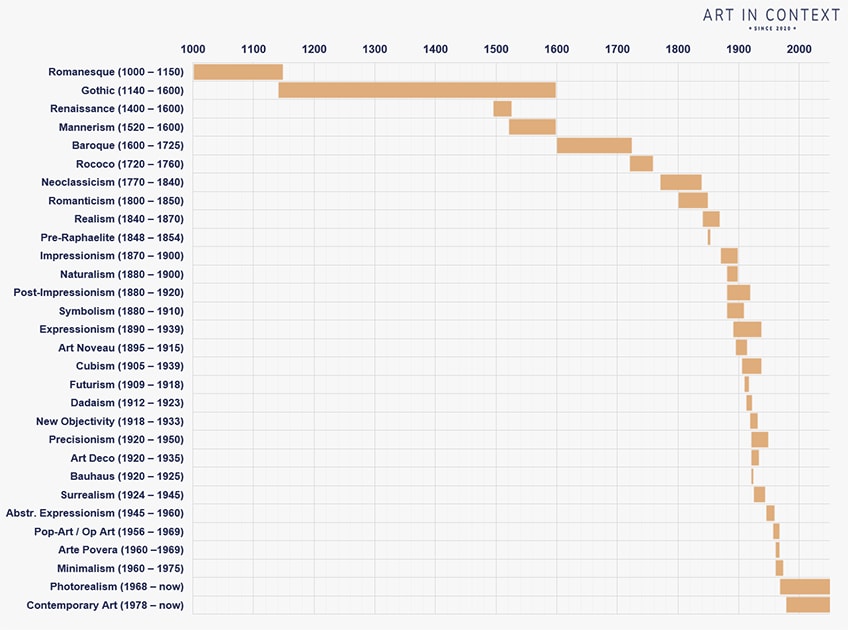
| Art Menstruation | Years |
| Romanesque | 1000 – 1150 |
| Gothic | 1140 – 1600 |
| Renaissance | 1495 – 1527 |
| Mannerism | 1520 – 1600 |
| Baroque | 1600 – 1725 |
| Rococo | 1720 – 1760 |
| Neoclassicism | 1770 – 1840 |
| Romanticism | 1800 – 1850 |
| Realism | 1840 – 1870 |
| Pre-Raphaelite | 1848 – 1854 |
| Impressionism | 1870 – 1900 |
| Naturalism | 1880 – 1900 |
| Mail service-Impressionism | 1880 – 1920 |
| Symbolism | 1880 – 1910 |
| Expressionism | 1890 – 1939 |
| Art Noveau | 1895 – 1915 |
| Cubism | 1905 – 1939 |
| Futurism | 1909 – 1918 |
| Dadaism | 1912 – 1923 |
| New Objectivity | 1918 – 1933 |
| Precisionism | 1920 – 1950 |
| Art Deco | 1920 – 1935 |
| Bauhaus | 1920 – 1925 |
| Surrealism | 1924 – 1945 |
| Abstract Expressionism | 1945 – 1960 |
| Pop-Fine art / Op Art | 1956 – 1969 |
| Arte Povera | 1960 – 1969 |
| Minimalism | 1960 – 1975 |
| Photorealism | 1968 – at present |
| Lowbrow Pop Surrealism | 1970 – now |
| Contemporary Art | 1978 – now |
Information technology may seem strange for our account of the art period timeline to finish 30 years ago. The concept of an fine art era seems inadequate to capture the variety of artistic styles that accept grown since the turn of the 21st Century. There is a feeling amongst some art historians that the traditional concept of painting has died in our era of fast-rails living. We do non take this opinion. Instead, nosotros keep to share our unique homo experiences through the medium of art, just as the cave people did, outside of our mod system of classification.
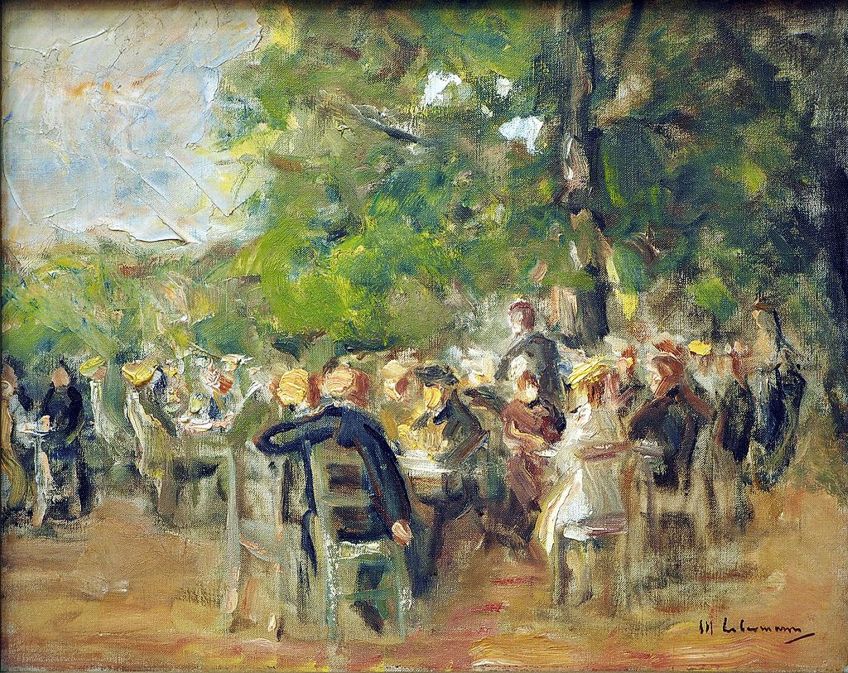 Biergarten (c. 1915) by Max Liebermann;Max Liebermann, Public domain, via Wikimedia Eatables
A Comprehensive Art Motility Timeline
Information technology is time to dive a niggling deeper into the social, cultural, and historical contexts of each of the singled-out art eras we presented higher up. You will come across how many eras take influence from those earlier them. Art, like human being consciousness, is continuously evolving. It is also important to annotation that this art timeline is a history of Western and predominantly European art.
The Romanesque Period (1000-1300): Sharing Information Through Fine art
Art historians typically consider the Romanesque art era to be the start of the art history timeline. Romanesque art developed during the ascension of Christianity ca. one thousand Ad. During this time, only a small pct of the European population were literate. The ministers of the Christian church building were typically part of this minority, and to spread the message of the bible, they needed an alternative method.
Christian objects, stories, deities, saints, and ceremonies were the sectional subject of most Romanesque paintings. Intended to teach the masses about the values and beliefs of the Christian Church, Romanesque paintings had to exist simple and easy to read.
As a consequence, Romanesque works of art are elementary, with assuming contours and clean areas of color. Romanesque paintings lack any depth of perspective, and the imagery is rarely of natural scenes. There were several dissimilar forms that Romanesque paintings could have, including wall paintings, mosaics, panel paintings, and book paintings.
Due to the Christian purpose behind Romanesque paintings, they are almost always symbolic. The relative importance of the figures within the paintings is shown by the size, with the more of import figures appearing much larger. You tin can see that human faces are frequently distorted, and the stories depicted in these paintings tend to accept a loftier emotional value. Romanesque paintings often include mythological creatures like dragons and angels, and almost always announced in churches.
At the nigh fundamental level, paintings of the Romanesque period serve the purpose of spreading the word of the bible and Christianity. The proper name of this art era stems from round arches used in Roman architecture, frequently plant in churches of the time.
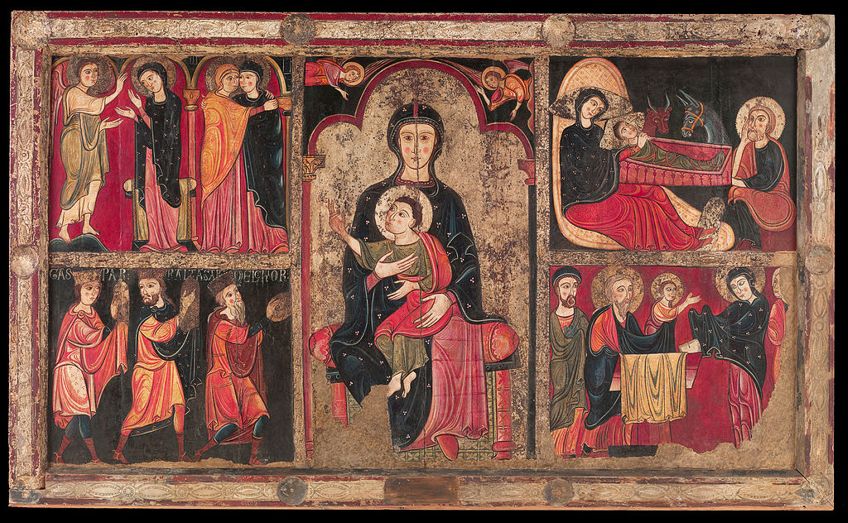 Altar frontal from Avià, c. 1200; Museu Nacional d'Art de Catalunya, Public domain, via Wikimedia Commons
The Gothic Era (1100-1500): Freedom and Fear Come up Together
One of the most famous eras, Gothic art grew out of the Romanesque period in France and is an expression of 2 contrasting feelings of the age. On the ane hand, people were experiencing and celebrating a new level of liberty of thought and religious agreement. On the other, there was a fear that the globe was coming to an terminate. You can clearly see the expression of these two contrasting tensions within the art of the Gothic period.
Just as in the Romanesque period, Christianity lay at the heart of the tensions of the Gothic era. As more freedom of thought emerged, and many pushed against conformity, the subjects of paintings became more diverse. The stronghold of the church began to dissipate.
Gothic paintings portrayed scenes of real human life, such as working in the fields and hunting. The focus moved away from divine beings and mystical creatures every bit more focus was given to the intricacies of what it meant to be human.
Human figures received a lot more attention during the Gothic menstruation. Gothic artists fleshed out more realistic human faces as they became more individual, less two-dimensional, and less inanimate. The development of a three-dimensional perspective is thought to have facilitated this modify. Painters also paid more attention to things of personal value like wearable, which they painted realistically with cute folds.
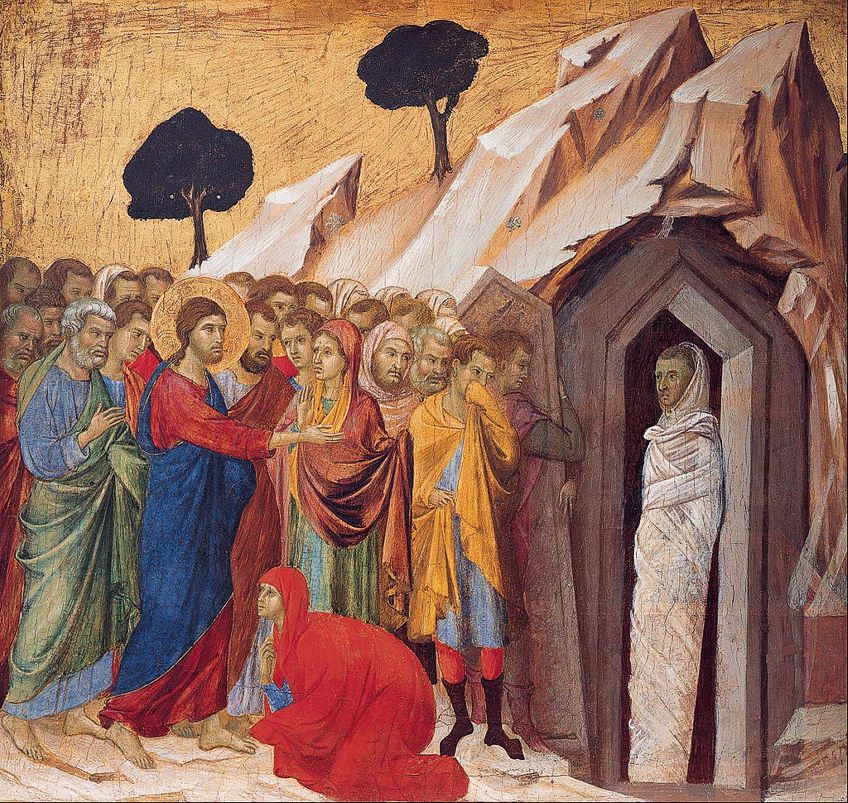 The Raising of Lazarus(1310-1311) by Duccio di Buoninsegna;Duccio di Buoninsegna, Public domain, via Wikimedia Commons
Many historians believe that part of the reason why the subjects of art became more diverse during the Gothic era was due to the increased surface area for painting within churches. Gothic churches were more than expansive than those of the Romanesque period, which is thought to represent the increased feelings of freedom at this time.
Alongside the newfound freedom of creative expression, there was a deep fearfulness that the end of the globe was coming. It is suggested that this was accompanied past a gradual refuse in faith in the church, and this in turn may have spurred the expansion of art outside of the church. In fact, towards the end of the Gothic era, works by Hieronymus von Bosch, Breughel, and others were unsuitable for placement inside a church.
We do not know many individual artists who painted in the Romanesque period, as fine art was not about who painted information technology but rather the message it carried. Thus, the move abroad from the church tin can too be seen in the enormous increase in known artists from the Gothic period, including Giotto di Bondone. Schools of art began to emerge throughout French republic, Italia, Germany, kingdom of the netherlands, and other parts of Europe.
The Renaissance Era (1420-1520): The Reawakening of an Art Era That Never Really Existed
The Renaissance era is peradventure one of the nigh well-known, featuring artists like Michelangelo and Leonardo da Vinci. This era continued to focus on the individual human as its inspiration and took influence from the fine art and philosophy of the aboriginal Romans and Greeks. The Renaissance can exist seen as a cultural rebirth.
A part of this cultural rebirth was the returned focus on the natural and realistic globe in which humans lived. The three-dimensional perspective became even more important to the art of the Renaissance, as is aptly demonstrated by Michelangelo'due south statue ofDavid.This statue harkened dorsum to the works of the ancient Greeks as it was consciously created to be seen from all angles. Statues of the last two eras had been two-dimensional, intended to be viewed only from the front end.
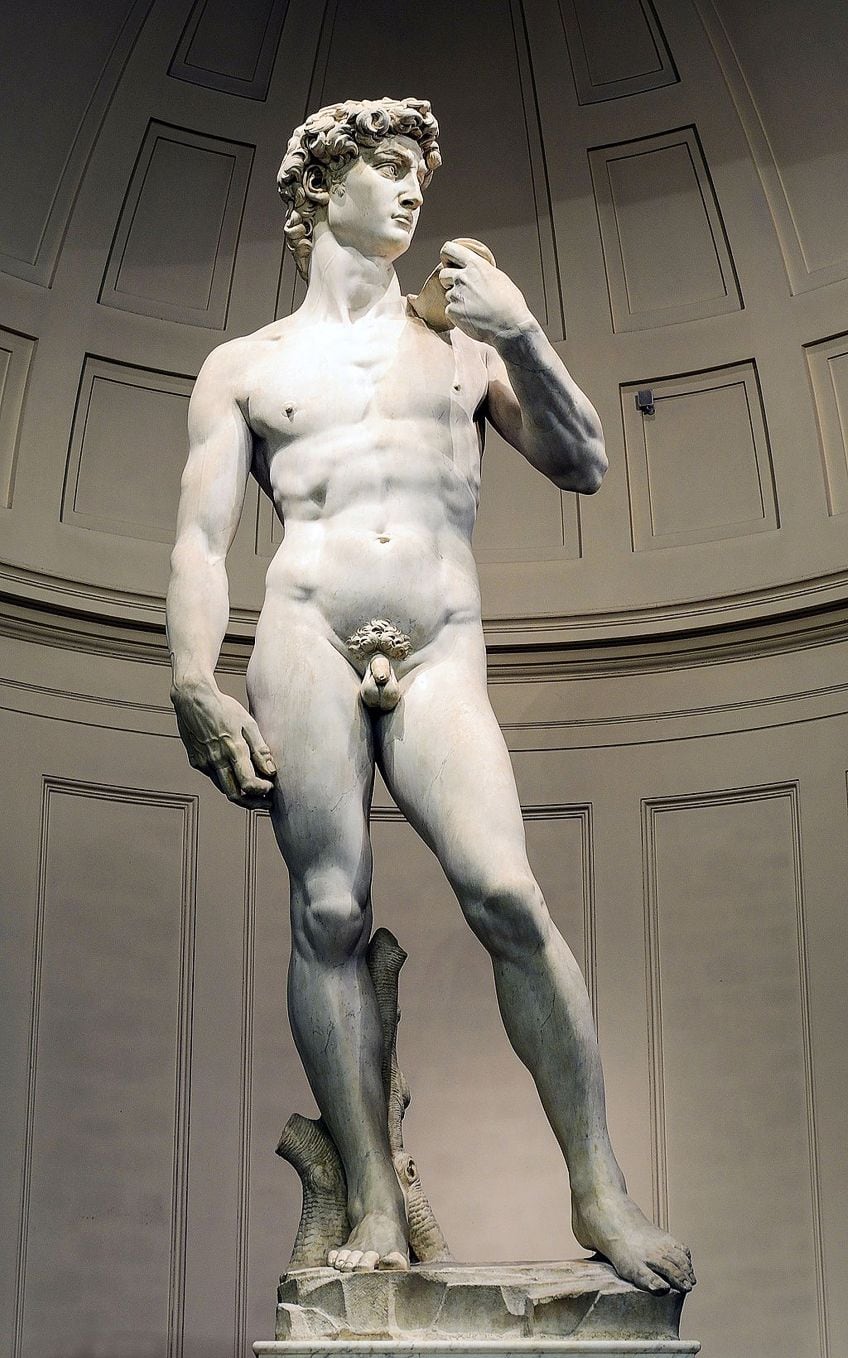 Michelangelo's David (1501-1504); Livioandronico2013, CC BY-SA four.0, via Wikimedia Eatables
The same three-dimensional perspective carried over into the paintings of the Renaissance era. Frescos that were invented around 3000 years prior were given new life by Renaissance painters. Scenes became more complex, and the representation of humans became much more nuanced. Renaissance artists painted human bodies and faces in three dimensions with a strong accent on realism. The paint used during the Renaissance menstruation also represented a shift from tempera paints to oil paints. The Renaissance menses is frequently credited as the very beginning of slap-up Dutch landscape paintings.
Mannerism (1520-1600): A Window into the Future of Kitsch
Of form, this heading is partly in jest. Not all of the art produced in this era is what we would sympathise today as "kitsch". What nosotros understand kitsch to mean today is frequently artificial, cheaply fabricated, and without much 'classic' sense of taste. Instead, the reason nosotros draw the art of this flow every bit being kitsch is due to the relative over-exaggeration that characterized it. Stemming from the newfound freedom of human being expression in the Renaissance period, artists began to explore their own unique and private artistic style, or manner.
Michelangelo himself, in fact, is not free from the exaggeration that distinguishes this era. Some art historians do not consider some of his later paintings to exist works of the Renaissance menstruum. The expression of feelings and human gestures, even items of article of clothing, is exaggerated deliberately in mannerist paintings.
The modest Due south-curve of the human body that characterizes the Renaissance style is transformed into an unnatural bending of the body. This is the commencement European style that attracted artists from across Europe to its birthplace in Italy.
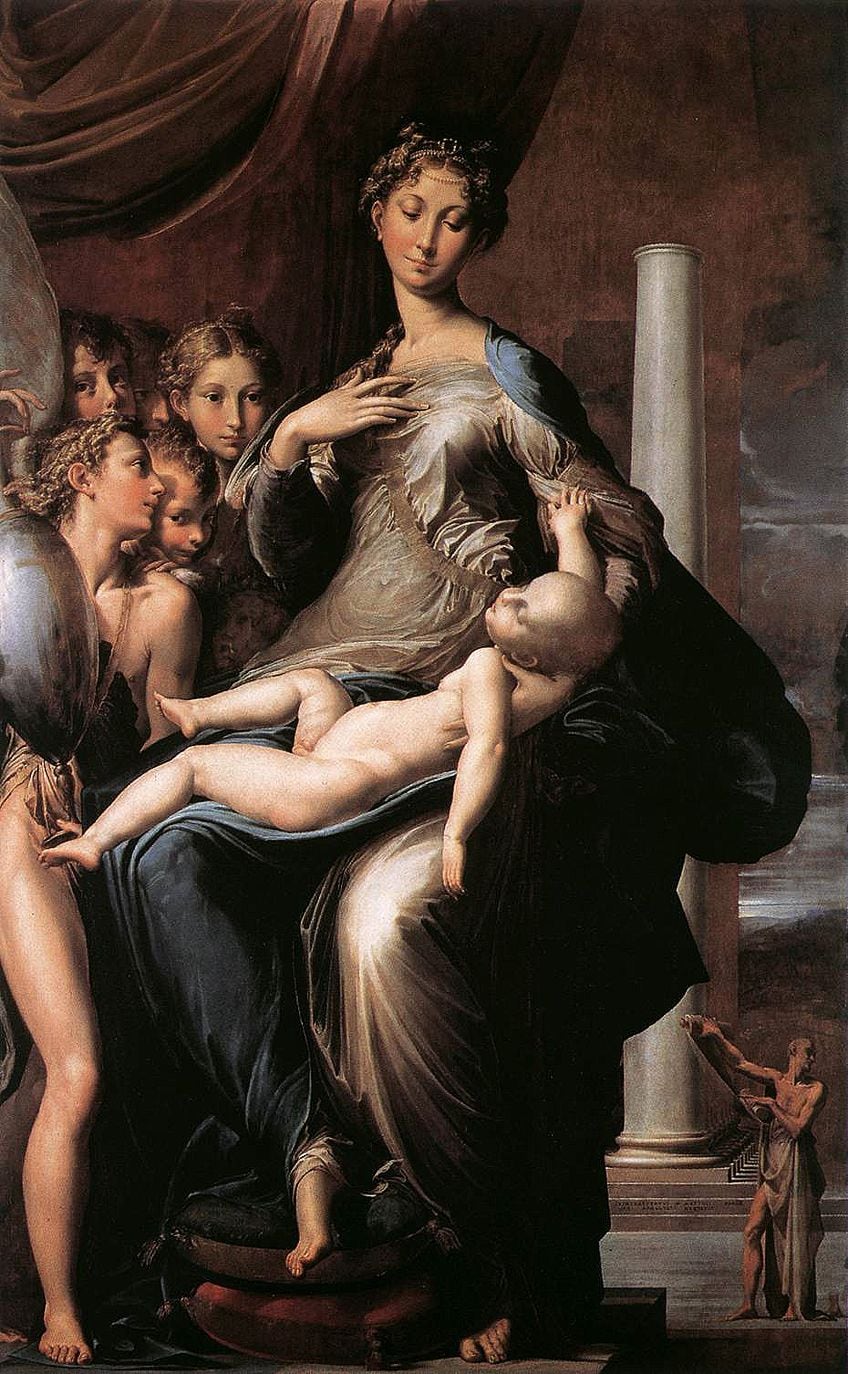 Madonna with Long Neck (1534-1540) past Parmigianino;Parmigianino, Public domain, via Wikimedia Commons
The Bizarre Era (1590-1760): The Glorification of Power and the Charade of the Centre
The progression of art celebrating the lives of humans over the ability of the divine connected into the Baroque era. Kings, princes, and even popes began to adopt to run across their own power and prestige celebrated through art than that of God. The over-exaggeration that classified Mannerism also connected into the Baroque period, with the scenes of paintings becoming increasingly unrealistic and magnificent.
Baroque paintings oftentimes showed scenes where Kings would exist ascending into the heavens, mingling with the angels, and reaching ever closer to the divinity and power of God. Here, we really tin can see the progression of human self-importance, and although the bailiwick matter does not move abroad entirely from religious symbolism, homo is increasingly the central power within the compositions.
New materials that glorify wealth and status similar gold and marble go the prized materials for sculptures. Opposites of light and dark, warm and common cold colors, and symbols of practiced and evil are emphasized beyond what is naturally occurring. Art academies increased in their numbers, every bit fine art became a way to display your wealth, power, and status.
 Baroque ceiling frescoes of Cathedral in Ljubljana, Slovenia. Work of Italian principal Giulio Quaglio in 1703–1706 and later 1721–1723;Petar Milošević, CC BY-SA iv.0, via Wikimedia Eatables
The Rococo Fine art Period (1725-1780): Calorie-free and Airy, a French Fancy
The paintings from the Rococo era are typical of the French aristocracy of the time. The name stems from the French word rocaille which means "shellwork". The solid forms which characterized the Baroque period softened into light, air, and desire. Paintings of this era were no longer strong and powerful, but light and playful.
The colors were lighter and brighter, most transparent in some instances. Many pieces of art from this period neglected religious themes, although some artists like Tiepolo did create frescos in many churches.
Much like the attitude of the French aristocracy of the time, the art of the Rococo period is totally removed from the social reality. The shepherd'due south idyll became the theme of this period, representing life equally lite and carefree, without the constraints of economic or social hardship.
Classicism (1770-1840): Throwing Information technology Back to Classic Times
Classicism, like the Rococo era, began in France in around 1770. In contrast to the Rococo era, however, Classism reverted to before, more than serious styles of artistic expression. Much like the Renaissance menstruation, Classisim took inspiration from archetype Roman and Greek fine art.
The art created in the Classicism era reverted to strict forms, two-dimensional colors, and human figures. The tone of these paintings was undoubtedly strict. Colors lost their symbolism. The fine art produced in this era was used internationally to instill feelings of patriotism in the people of each nation. Parts of Classicism include Louis-Sieze, Empire, and Biedermeier.
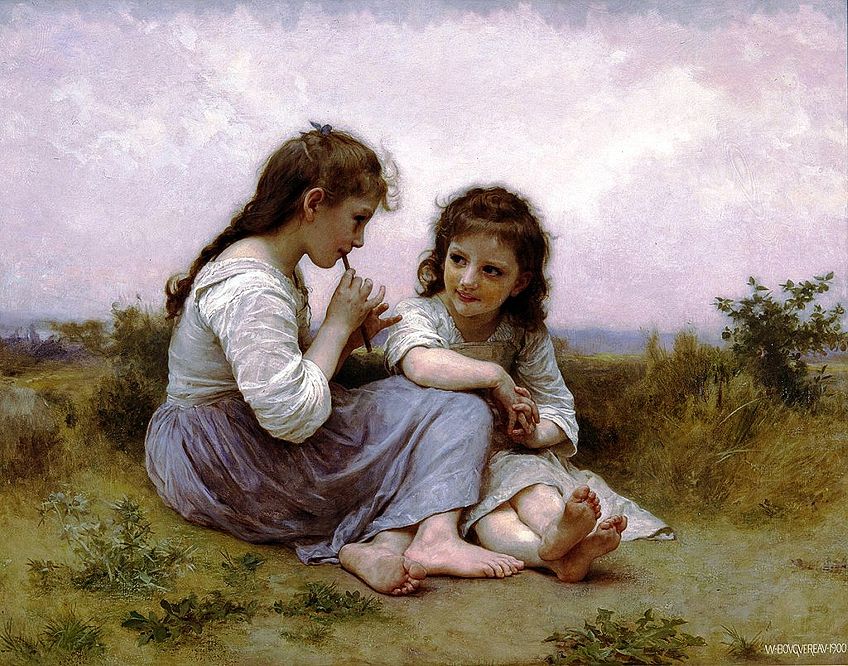 A Childhood Idyll (1900) by William Bouguereau;William-Adolphe Bouguereau, Public domain, via Wikimedia Commons
Romanticism (1790-1850): A Break from the Severity of it All
You can run across from the dates that this fine art era occurred at around the same time equally Classicism. Romanticism is often seen equally an emotionally charged reaction to the stern nature of Classicism. In dissimilarity to the strict and realistic nature of the Classicism era, the paintings of the Romantic era were much more sentimental.
The exploration of the intangible; emotions and the subconscious, took center-stage. Effectually this time, people began to become hiking in an endeavor to explore the natural world. It was not, yet, the truthful reality of the natural earth which they intended to discover, but the mode information technology made them feel.
There is no tangible or precisely determinable style to the art of the Romanticism menses. English and French painters tended to focus on the effects of shadows and lights, while the fine art produced by German painters tended to have more gravity of thought to them. The Romantic painters were often criticized and even mocked for their interpretation of the world around them.
Realism (1850-1925): Objectivity over Subjectivity
Every bit the Romanticism era was a reactionary motion to the Classicism menstruum earlier it, so is Realism a reaction to Romanticism. In dissimilarity to the cute and deeply emotional content of Romantic paintings, Realist artists presented both the skilful and beautiful, the ugly and evil. The reality of the earth is presented in an unembellished way by Realism painters.
These artists endeavor to show the earth, people, nature, and animals, as they truly are. There is a focus on the "obligation of art into truth" every bit Gustave Courbet puts information technology.
Just as with Romanticism, Realism was not pop with anybody. The paintings are not particularly pleasing to the center and some critics have commented that despite the artist's claims of realism, erotic scenes somehow miss the real eroticism. Goethe criticizes Realism, maxim that art should be ideal, non realistic. Schiller too calls Realism "mean," indicating the harshness that many of the paintings portray.
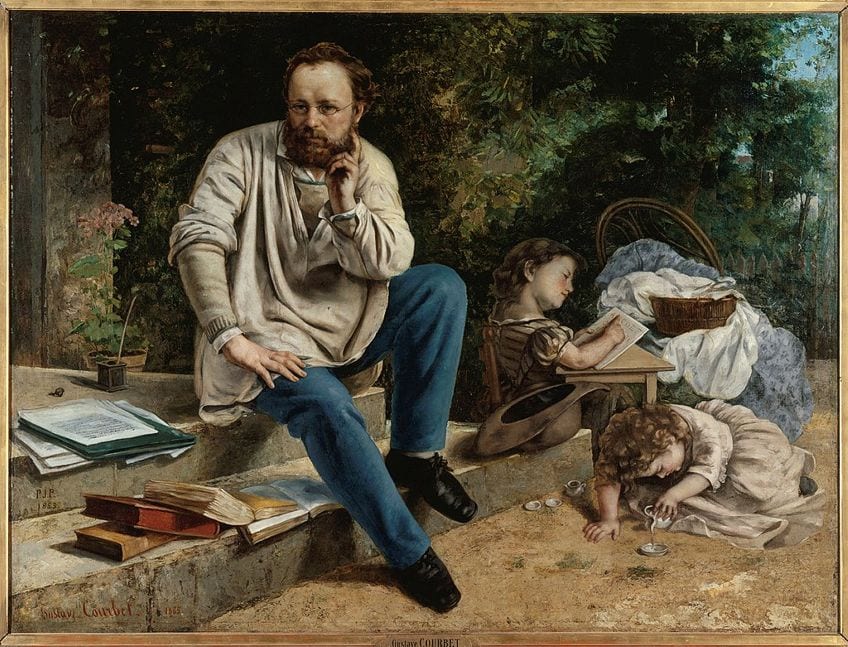 Proudhon and His Children(1865) by Gustave Courbet; Gustave Courbet, Public domain, via Wikimedia Eatables
Impressionism (1850-1895): Heralding the Era of Modernistic Art
Historians often pigment the Impressionist movement as the beginning of the modern age. Impressionist art is said to accept closed the book on classical music and other classical forms of art. Impressionism is as well perhaps, later on Cubism, 1 of the most hands recognizable art periods. Featuring artists like Claude Monet and Vincent van Gough, Impressionism broke abroad from the smoothen brush strokes and areas of solid color that characterized many fine art periods before it.
Initially, the word Impressionism was like a swear discussion in the art globe, with critics believing that these artists did non paint with technique, merely rather but smeared pigment onto a sail. The brushstrokes indeed were a significant departure from those that came earlier them, sometimes condign furiously wild. Distinct shapes and lines disappeared into a cyclone of colors. Private dots of completely new colors were put together, particularly in the pointillism diverseness of Impressionist paintings. The subjects of Impressionist paintings could often only be recognized from a altitude.
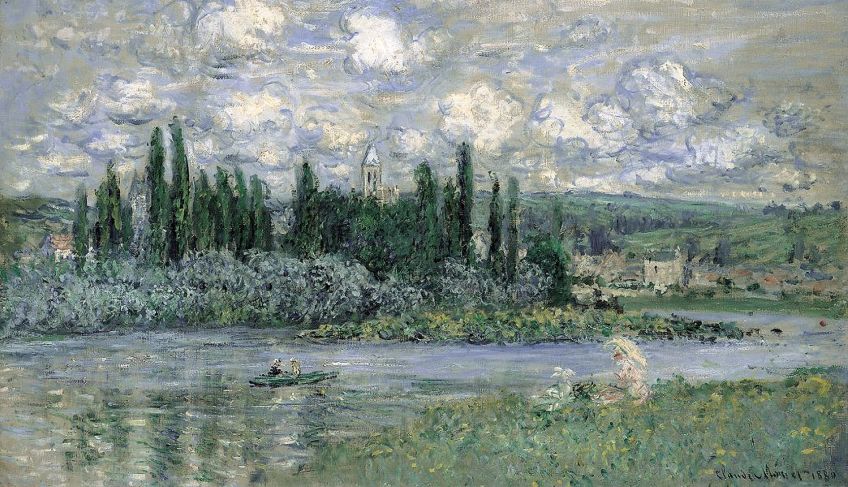 View of Vetheuil sur Seine(1880) by Claude Monet;Claude Monet, Public domain, via Wikimedia Commons
A meaning change that occurred during the Impressionist era was that painting began to take place "en-plein-air," or outside. Much of the Impressionist artist's ability to capture the circuitous and ever-changing colors of the natural earth were a issue of this shift.
Impressionist artists too began to move away from the desire to lecture and teach, preferring to create fine art for art's sake. Galleries and international exhibitions became increasingly of import.
Symbolism (1890-1920): There is Always More Meets the Eye
During this catamenia, the era of Symbolism began to accept hold in French republic. Artists became preoccupied with the representation of feelings and thoughts through objects. The favorite themes of the Symbolism move were death, sickness, sin, and passion. The forms were mostly articulate, a fact which art historians believe was anticipating the Art Nouveau era.
Art Nouveau (1890-1910): The Pure Gilded of Gustav Klimt
Although Gustav Klimt was by no means the most important creative person in the Art Nouveau motility, he is i of the most well-known. His fashion perfectly encapsulates the Art Nouveau move with soft, curved lines, lots of florals, and the stylistic characterization of human figures. In many countries, this style is known every bit the Secession style.
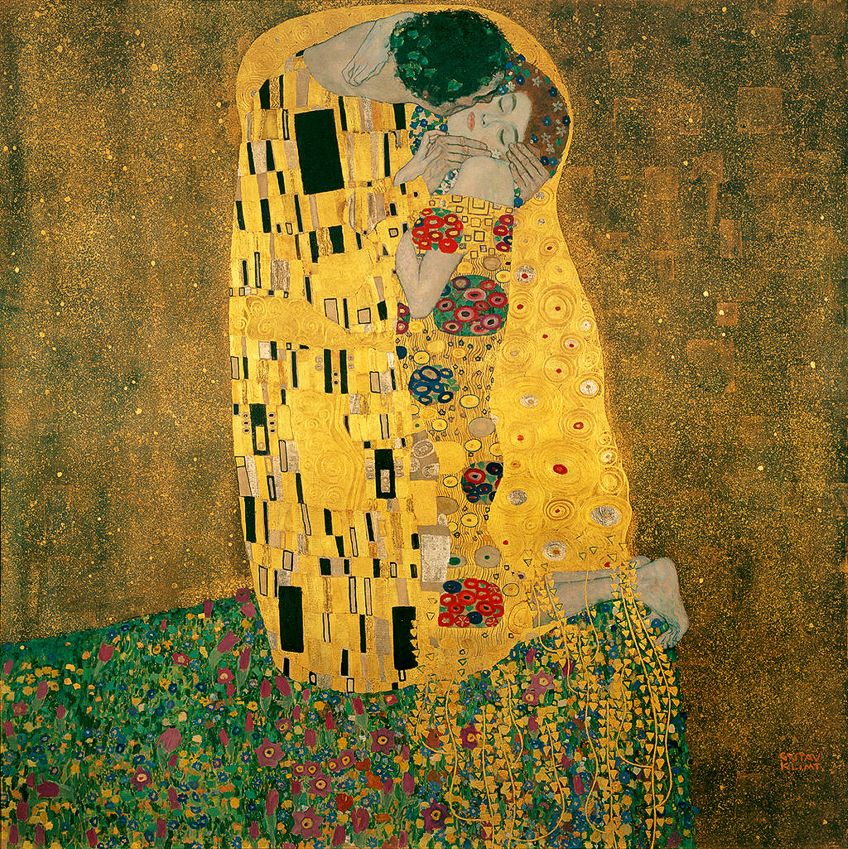 The Kiss (1907-1908) by Gustav Klimt;Gustav Klimt, Public domain, via Wikimedia Eatables
The art produced in the Art Nouveau menstruum includes a lot of symmetry and is characterized past playfulness and youthfulness. Fine art Nouveau has a lot of political content, although many critics ignore this and hold the decorative aspects confronting it. Through the art of the Art Nouveau period, artists attempted to bring nature back into industrial cities.
Expressionism (1890-1914): Bringing a Political Edge to the Debate
In the Expressionism art era, we one time again see a resurgence of the importance of the expression of subjective feelings. The artists inside this movement were not interested in naturalism or what things wait like on the outside. As a event, there is a certain tinge of assailment in some Expressionist paintings, which are often primitive and slightly wild.
Expressionism originated in Germany and is intended to dissimilarity Impressionism. Towards the beginning of the Offset World War, Expressionist paintings had a agonizing intensity near them. Intended to criticize power and the standing social order, Expressionism spread these political ideas through the medium of paint. Art was get-go to become political.
Cubism (1906-1914): Breaking Things Apart and Putting Them Back Together Again
Beginning with two artists, Pablo Picasso and Georges Braque, the Cubist movement was all nearly fragmentation, geometric shapes, and multiple perspectives. The dimensional planes of everyday objects were cleaved down into dissimilar geometric segments and put back together in a way that presented the object from multiple sides simultaneously.
Cubism was a rejection of all the rules of traditional western painting and has had a strong influence on the styles of art that accept followed it.
 Guitar and Spectacles (1912) by Juan Gris;Juan Gris, Public domain, via Wikimedia Commons
Futurism (1909-1945): Artistic Riot
Futurism is less of an artistic mode and more of an artistically inspired political movement. Founded by Tommaso Marinetti'southFuturist Manifesto, which rejected social organisation and Christian morality, the Futurist era was full of chaos, hostility, aggression, and anger. Although Marinetti was not a painter himself, painting became the most prominent form of art inside the Futurist movement.
These artists vehemently rejected the rules of Classical painting, assertive that everything that was passed through generations (beliefs, traditions, religion) was suspicious and dangerous. The militant nature of the Futurist movement has resulted in many people believing that it was also shut to fascism.
Dadaism (1912-1920): The True Reality That Life is Nonsense
Dada means a neat many things and nothing at all. The author Hugo Ball discovered that this small word has several different meanings in different languages and at the same time, every bit a word, information technology meant cipher at all. The Dadaism motion is based on the concepts of illogic and provocation and was seen equally not but an fine art move, only an anti-state of war movement.
The illogic of existing rules, norms, traditions, and values was called into question by the Dadaist movement. The fine art move encompassed several art forms including writing, poetry, dance, and performance art. Part of the movement was to call into question what could be classified equally "art".
Dadaism represents the ancestry of action art in which painting becomes more just a portrait of reality, but rather an affiliation of the social, cultural, and subjective parts of being human.
Surrealism (1920-1930): Things Just Get More Bizzare
Every bit if the pure illogic nature of the Dadaism movement was not outlandish enough, the Surrealists took the dream world to be the fountain of all truth. One of the most famous Surrealist artists is Salvador Dali, and you are bound to know his painting Melting Watch (1954).
Surrealism is fundamentally psychoanalytical, and many Surrealist artists would paint direct from their dreams. Sometimes dealing with uncomfortable concepts, hidden desires, and taboos, Surrealism was a direct critique of the ingrained ideas and beliefs of the bourgeoise. As you lot can imagine, this style of art was not popular when it began, but information technology has greatly influenced the world of modern fine art.
 Space and fourth dimension (in homage to 50.5. Beethoven) (1974) by Italian painter William Girometti;William Girometti, CC BY-SA 3.0, via Wikimedia Commons
The New Objectivity (1925-1965): Cold and Technical
Equally the surrealists were attempting to move abroad from the world of physical, concrete, and visible objects, the New Objectivity motion turned towards these ideas. Many of the themes within New Objective art were social critiques. The turbulence of the war left many people searching for some kind of gild to concord onto, and this can be seen conspicuously in the art of New Objectivity.
The images represented in New Objectivity were often cold, unemotional, and technical, with some favorite subjects being the radio and lightbulbs. As is the instance with many modern movements in art, there were several different wings to the New Objectivity movement.
Abstract Expressionism (1948-1962): Stepping Abroad from Europe
Abstract Expressionism is said to be the first art move to originate outside of Europe. Emerging from North America, Abstruse Expressionism focused on color-field painting and action paintings. Rather than using a sail and a brush, buckets of paint would be poured on the ground, and artists used their fingers to create images.
With well-known artists like Marc Tobey and Jackson Pollock, this art movement was distinct from any that came before it. The application of the paint was sometimes so thick that the finished slice would take on a form dissimilar any painting before it. Abstruse Expressionism spread throughout Europe. Equally with all art, there are always critics, with conservative Americans during the cold state of war calling it "un-American."
Pop-Art (1955-1969): Art is Everything
For the artists of Pop-Art, everything in the world was art. From advertisements, tin cans, toothpaste, and toilets,everythingis art. Pop-Art developed simultaneously in the United States and England and is characterized by compatible blocks of color and articulate lines and contours. Painting and graphic art became influenced by photorealism and serial prints. One of the most famous English Popular artists is David Hockney, although only a few of his lifetime paintings were in this motion.
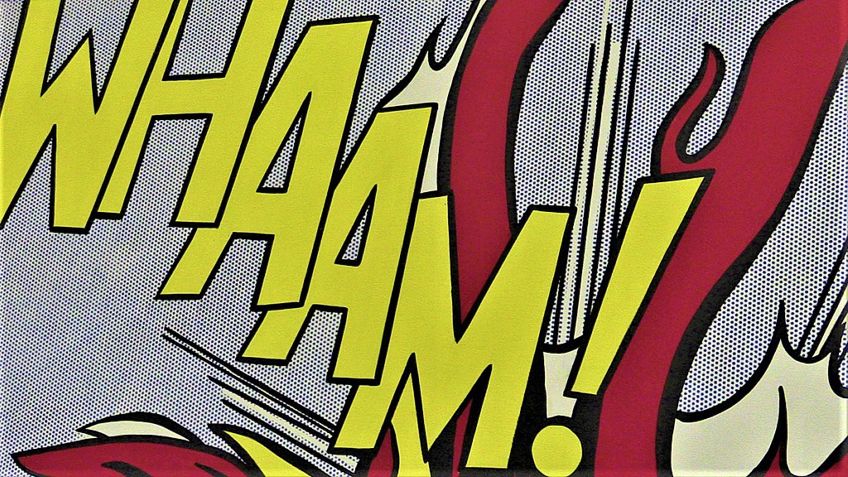 A detail of Roy Lichtenstein's Wall Explosion II, 1965; Colin McLaughlin, CC Past-SA four.0, via Wikimedia Eatables
Neo-Expressionism (1980-1989): Mod Fine art
Starting in the 1980s, Neo-Expressionism emerged with large-format representational and life-affirming paintings. Berlin was a fundamental point for this new movement, and the designs typically featured cities and large-city life. The proper name Neo-Expressionism emerged from Fauvism, and although the artists in Berlin disbanded in 1989, some artists continued to pigment in this style in New York.
Art is a fundamental part of what it ways to be human being. Many of the troubles and joys nosotros experience can but be captured accurately through artistic expression. We promise that this short summary of the art periods timeline has helped you gain some more insight into the contexts surrounding some of the most famous works of art created by the human being race.
Nosotros've as well created a web story about art periods.
Source: https://artincontext.org/art-periods/
0 Response to "This Is First Time in the History of Art Expressed That Abstract Ideas Were Represented by Images"
Enviar um comentário